
Managing vendor risk across an expanding supply chain without visibility into real time threats or compliance gaps eats time and attention. Most competitors lock advanced features or integrations behind opaque enterprise pricing or require suppliers to participate actively for full risk detection. You can match the price, deployment speed, and collaborative features of three alternatives to your organisational size and supply chain scope.
Table of Contents
PilotVantage
At a Glance
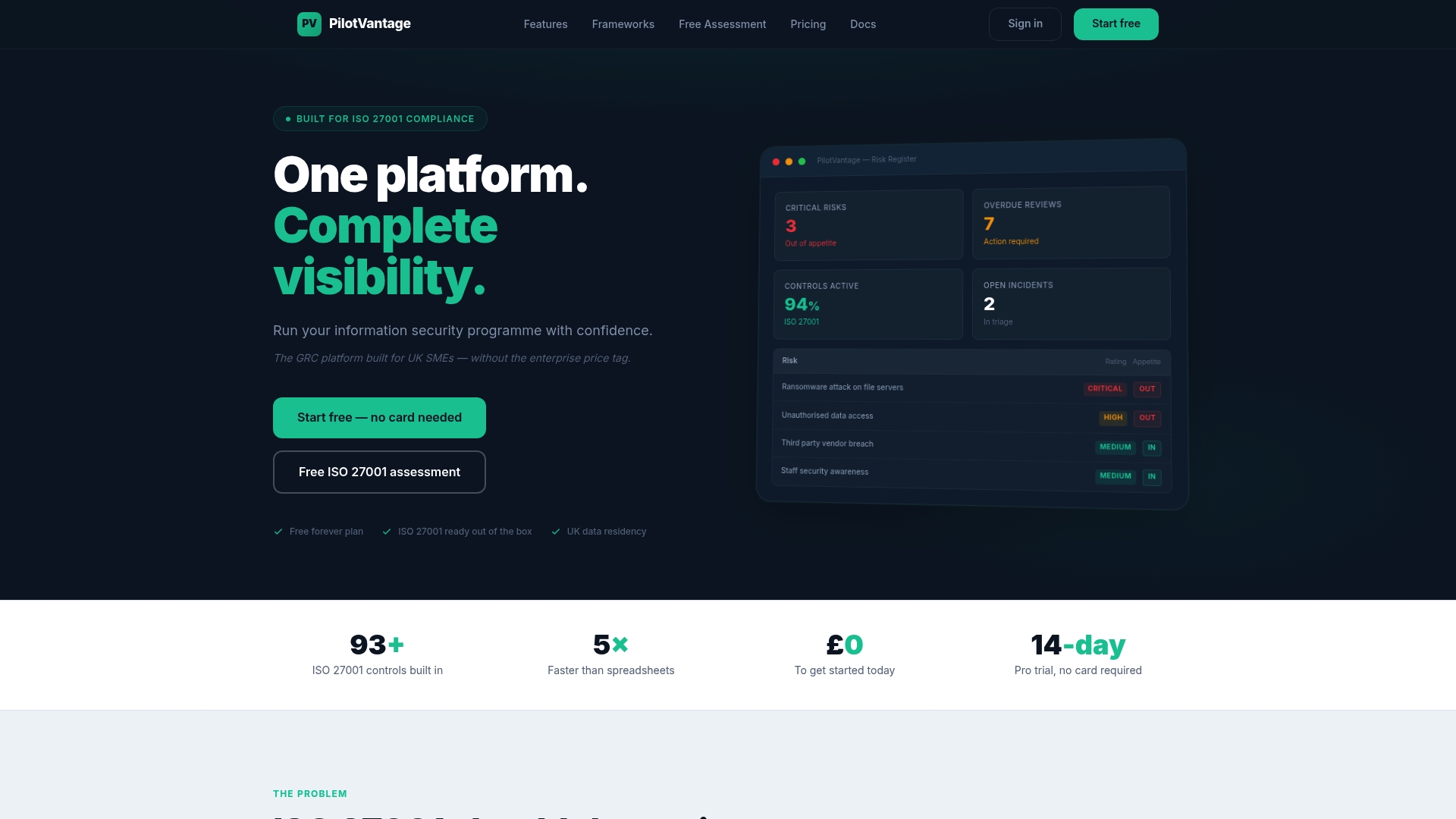
A forever free plan sits alongside paid tiers starting at £49/month, with a 14-day free trial for paid accounts. The platform ships preloaded standards such as ISO 27001:2022, Cyber Essentials, SOC 2 Type II, NIST CSF, and GDPR to reduce setup time. It targets UK SMEs asked by clients, insurers, or regulators to demonstrate their security posture without enterprise cost.
Core Features
The Risk Register includes dynamic scoring and heatmaps linked to incident records and corrective actions. Preloaded ISO 27001 controls generate an automatic Statement of Applicability to speed audit readiness. Policy creation, version tracking, evidence linking, third party vendor risk records, and staff training modules keep everything an auditor asks for in one organised place.
Key Differentiator
Built specifically for SME ISO 27001 compliance with preloaded controls, UK data residency, and a forever free plan. That focus reduces configuration work most small teams face when moving from spreadsheets to a managed system. The product is expanding from ISO 27001 into Cyber Essentials, PCI DSS, and the NHS DSP Toolkit over the next 12 months.
Pros
PilotVantage makes ISO 27001 projects reachable for operations teams by shipping preloaded controls and workflows that cut initial setup time. Integrated dashboards provide visible progress across risk registers, incidents, audits, and policies so managers do not chase scattered spreadsheets. Flexible billing plus a free plan let small organisations start with minimal spend, and ISO 27001 consultants can white label the platform for client engagements.
Cons
- Newer platform, so a smaller integration marketplace than legacy vendors
Who It’s For
SME organisations in the UK, typically 10 to 250 employees, pursuing ISO 27001 compliance on a budget will find the feature set suited to their needs. Operations managers and small security teams that do not have a full-time CISO will appreciate guided workflows and audit-focused documentation. ISO 27001 consultants and vCISOs can use PilotVantage as a white label channel platform to replace spreadsheets and manual evidence collection.
Unique Value Proposition
White label support for ISO 27001 consultants and vCISOs lets them run repeat client engagements on PilotVantage instead of rebuilding controls in spreadsheets. That model turns compliance work into a packaged service and reduces repeated setup time across projects. For an SME, it means an operations manager can progress certification steps without hiring a full-time specialist.
Real World Use Case
A professional services firm used PilotVantage to record risks, log incidents, assign corrective actions, and plan audits. The team linked policies to evidence and tracked progress through ISO 27001 clauses instead of keeping multiple Excel files. Audit readiness moved from ad hoc preparation to continuous documentation the auditor could review.
Pricing
Pricing starts with a free forever plan and paid tiers from £49/month for Essential and £149/month for Professional. Enterprise pricing is custom and billed monthly or annually, and paid tiers include a 14 day free trial. The free plan limits risk entries and user seats which may require an upgrade as teams grow.
Website: https://pilotvantage.com
3rdRisk
At a Glance
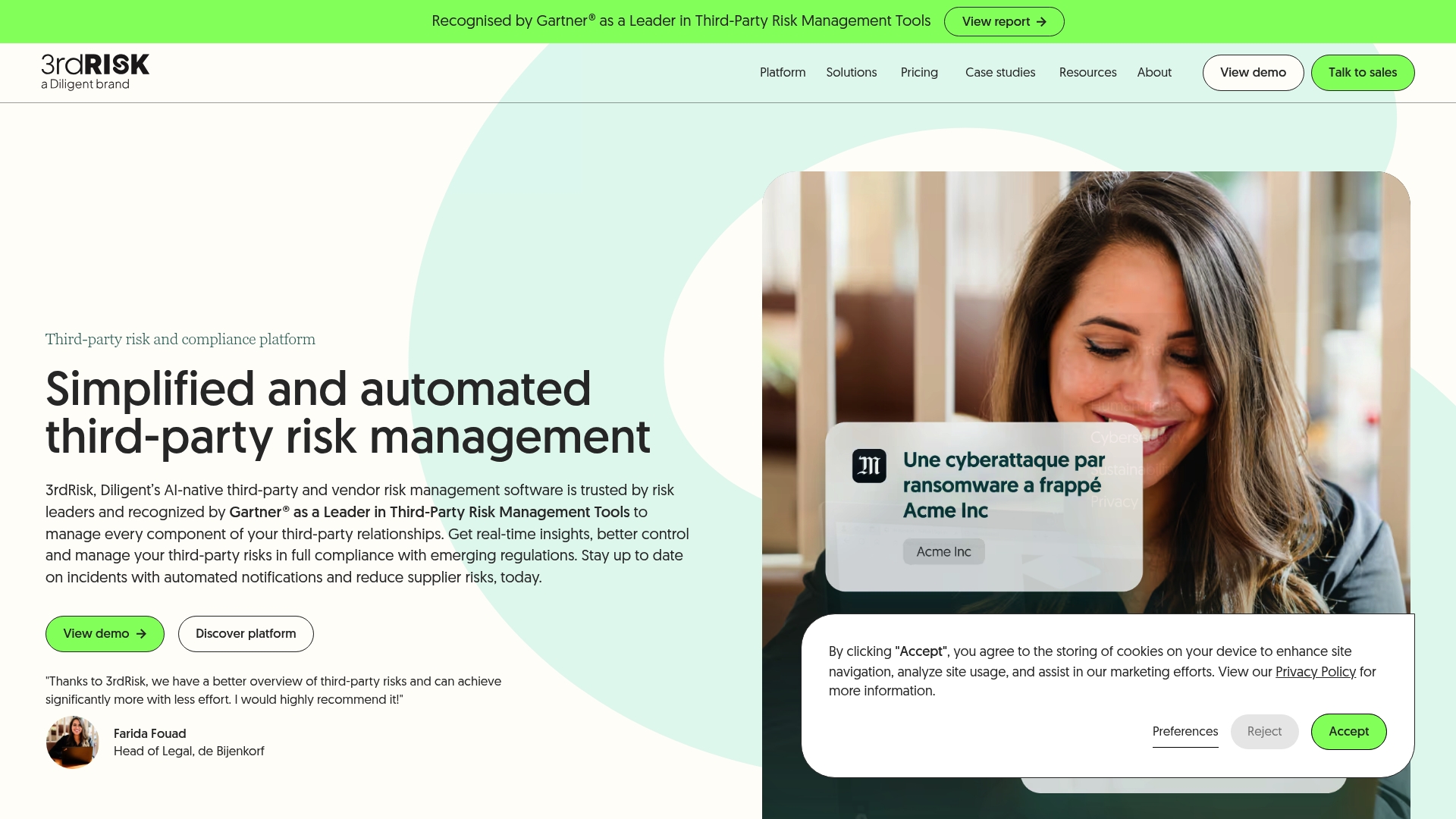
3rdRisk reports it is trusted by over 1,000 risk professionals and that Gartner positions it as a Leader in third party risk management tools. The vendor advertises an AI native platform that covers multiple risk domains and regulatory frameworks such as DORA and NIS‑2. The company states typical implementations complete in under 10 days with dedicated support.
Core Features
The platform centralises assessment workflows across cybersecurity, privacy, sustainability, and other domains while offering customisable assessment templates and supplier portals. It combines automated document analysis with real time insights and incident alerts to reduce manual review tasks. Out of the box connections to data sources and GRC systems support continuous monitoring and reporting.
Key Differentiator
3rdRisk’s principal difference is the AI native approach combined with broad domain coverage and a strong integration catalogue. That focus aims to let teams automate evidence review and surface risk signals from multiple data feeds. The vendor claims rapid deployment and the integrations catalogue makes it feasible to replace several point tools with a single platform.
Pros
The company highlights Gartner recognition and a reported user base that signals market traction and analyst visibility. The product is highly configurable with multiple frameworks and risk domains, which helps firms map their regulatory obligations. The interface reads as user friendly and the vendor advertises fast deployment within the stated implementation window, backed by ongoing support and optimisation.
Cons
- Complexity may overwhelm very small organisations without a dedicated risk team. Smaller teams will likely need vendor help to configure workflows.
- Pricing is not publicly listed and appears geared to enterprise customers, which may put it beyond the budgets of small to mid sized firms.
- Heavy reliance on integrations and configurations means the platform delivers value fastest when those connections are in place.
When It May Not Fit
If you run a small organisation with a single risk owner and limited technical resource, the implementation effort may outweigh the benefits. If you need a simple questionnaire tool with minimal integrations, this product is likely more capability than you require. If budget transparency matters up front, the lack of public pricing will slow procurement.
Notable Integrations
- Microsoft Teams
- Dun & Bradstreet
- BitSight
- Ecovisad
- Creditsafe
- OpenSanctions
- Refinitiv
- Jira
Who It’s For
Large organisations and enterprises with complex supply chains, regulatory obligations, and a need to centralise vendor data. Teams that must demonstrate compliance with DORA, NIS‑2, GDPR, or run sustainability assessments will find the domain coverage useful. The product suits buyers who can commit technical resource to integrate and configure the system.
Real World Use Case
A multinational retailer centralised third party data into the platform to automate risk assessments and monitor incidents in real time. The retailer used the system to collate evidence for GDPR, NIS‑2, and DORA audits, which reduced manual tracking and sped up response to supplier incidents.
Pricing
Pricing is not publicly specified and appears to follow an enterprise model. Contact sales for a tailored quote and licensing details, as the vendor typically scopes deployments to organisational size and integration needs.
Website: https://3rdrisk.com
Risk Ledger
At a Glance
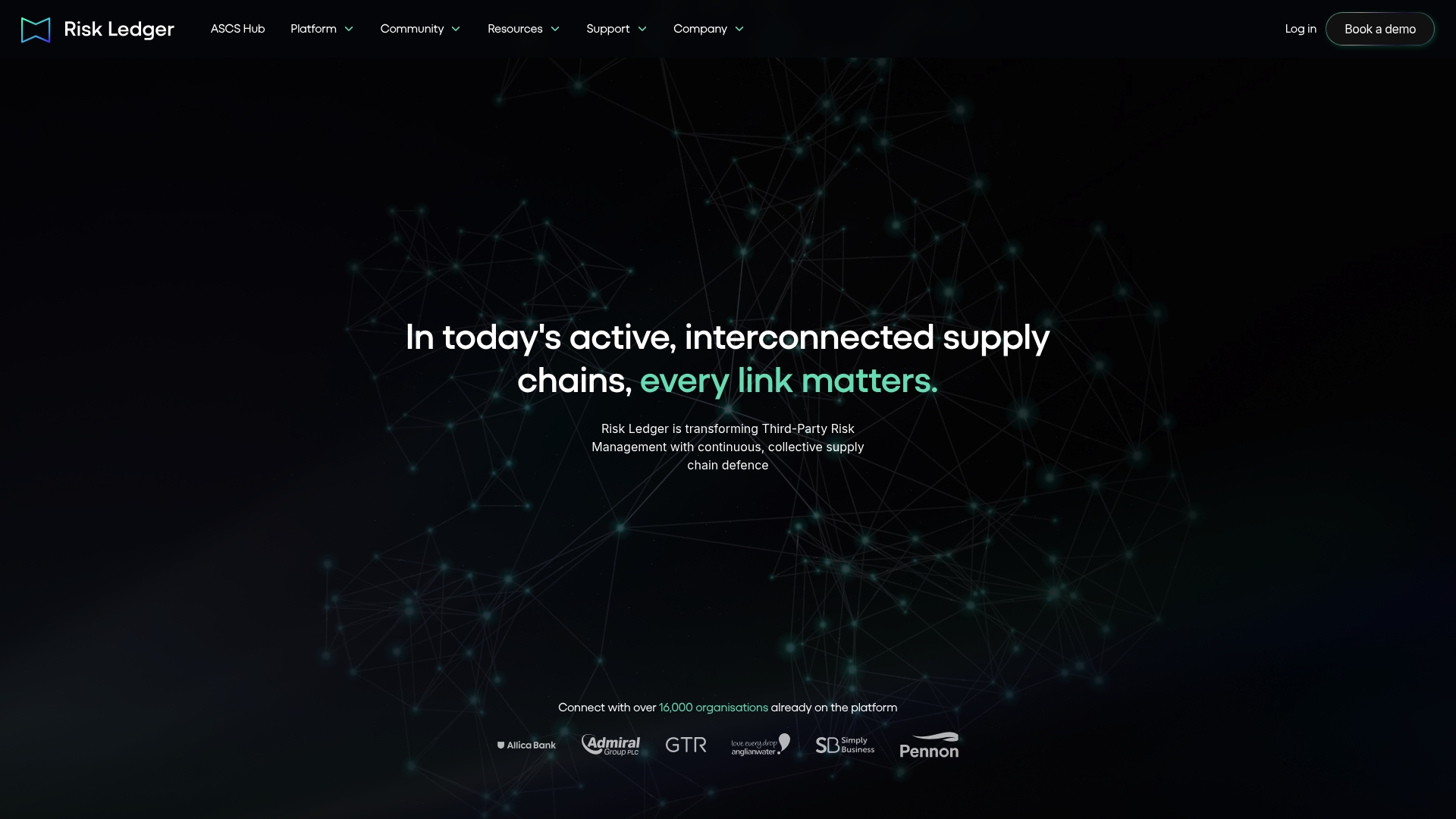
Risk Ledger reports a network of over 16,000 organisations. That scale lets you instantly view supplier security profiles and share standardised assessments across peers. The platform also advertises real time risk signals and visual tools to map concentration risks, which accelerates collective responses to emerging threats.
Core Features
The platform offers instant supplier security profiles and a system to send and receive standardised assessment questionnaires, making supplier onboarding more consistent. It also gives tools to visualise supply chain networks and to spot concentration risks while providing real time monitoring of threats and vulnerabilities. Collaboration features let members share intelligence and assess compliance with certifications such as ISO27001.
Key Differentiator
The product’s single distinct advantage is that network scale. That network above supports cross organisational intelligence sharing and reduces duplicate assessments for many suppliers. The result is faster visibility into weak links and a clearer picture of nth party exposure across extended supply chains.
Pros
A large membership pool supports collaborative risk detection and reduces the work of repeating assessments. That network amplifies threat signals and peer intelligence, which helps security and procurement teams prioritise follow up. The mix of instant profiles, visual supply chain maps, and questionnaire templates suits organisations that need to coordinate responses across many suppliers.
Cons
- Risk detection depends on active participation from the network. If suppliers do not share data, coverage gaps will appear.
- Advanced features may require onboarding and integration effort. Expect a learning curve for suppliers and internal teams.
- Pricing is not publicly disclosed. Smaller organisations may struggle to assess total cost before engaging.
When It May Not Fit
If you manage a handful of suppliers or need transparent, out of the box pricing, this product will likely feel oversized. Organisations that cannot persuade suppliers to participate will not see the full benefit. Teams that require turnkey integrations for existing vendor portals may find implementation resource heavy.
Who It’s For
This platform fits large organisations with extensive supply chains and dedicated procurement or security teams. Use it when you need to peer shared intelligence, standardised assessments across many suppliers, and tools to explore concentration risk. It is less suitable for small teams buying a simple checklist solution.
Real World Use Case
A large manufacturer connects with thousands of suppliers on the network and issues standardised questionnaires to assess security compliance. The team visualises concentration risk around critical components and monitors vulnerability signals for suppliers. They then share mitigation notes with industry peers to reduce systemic exposure.
Website: https://riskledger.com
Comparison of alternatives
The landscape of third party risk management software offers diverse capabilities, each tailored to distinct business requirements. While PilotVantage focuses on providing tools specialised in ISO 27001 compliance for SMEs, 3rdRisk offers expansive configurability and domain breadth, and Risk Ledger relies on a large network for collaborative supplier risk insights. This comparison will explore the distinguishing characteristics of each platform in more detail.
Key strengths in supplier network capabilities
Risk Ledger’s significant advantage lies in its large, active network of over 16,000 organisations. This collective approach allows companies to share assessments and intelligence, improving the speed and efficiency of identifying potential risks within their supplier ecosystems. Such a feature is especially beneficial for enterprises managing diverse and extensive supply chains where peer collaboration can mitigate risks effective coordination through connected suppliers.
Accessibility and usability for small to medium enterprises
PilotVantage offers a streamlined solution tailored for SMEs pursuing ISO 27001 compliance, often without a dedicated security team. By including preloaded controls aligned with the standard, organisations can shave extensive time off the compliance setup process. The inclusion of flexible and affordable billing options, along with a forever free plan, makes it accessible to businesses with constrained budgets.
Best fit
- For SMEs in the United Kingdom seeking a cost-effective and user-friendly ISO 27001 compliance solution, PilotVantage offers significant time-saving workflows and financial accessibility.
- Large organisations with complex regulatory requirements and established risk management teams will find 3rdRisk’s broad configurability and diverse integration options.
- Companies with broad supply chains that value collaborative intelligence and extensive supplier networks should prioritise Risk Ledger for its large organisational pool and shared risk data model.
Our pick
For SMEs focused on achieving ISO 27001 compliance swiftly and efficiently without extensive resource allocation, PilotVantage represents the choice. Its preloaded controls and budget-conscious pricing enable effective progress for teams that might otherwise struggle with manual processes. However, for larger organisations with broader compliance needs or those seeking collaborative supply chain intelligence, the alternatives may present more aligned solutions.
Choosing the appropriate solution depends on factors such as features offered, suitability for organisational size, and specifics of your governance compliance requirements.
| Product | Key Use Case | Unique Feature | Pricing | Limitation |
|---|---|---|---|---|
| PilotVantage | SME ISO 27001 compliance initiatives | Preloaded ISO standards | Free plan; Paid plans start at £49/month | Newer platform; smaller integration marketplace than legacy vendors |
| 3rdRisk | Centralising various compliance workflows | AI native platform with integrations | Price not published | Complexity may challenge small organisations |
| Risk Ledger | Mapping supplier concentration risks | Large network enabling peer sharing | Price not published | Dependency on network participation |
How Can UK SMEs Manage Third Party Risk Without Enterprise Complexity?
Managing third party risk can feel daunting for UK SMEs facing client or regulatory demands. PilotVantage offers a tailored GRC platform that helps small and medium businesses handle risks, policies, audits, vendor assessments, and evidence collection in one organised place. Its preloaded ISO 27001 and Cyber Essentials controls reduce setup time and guide operations managers without full-time security specialists.
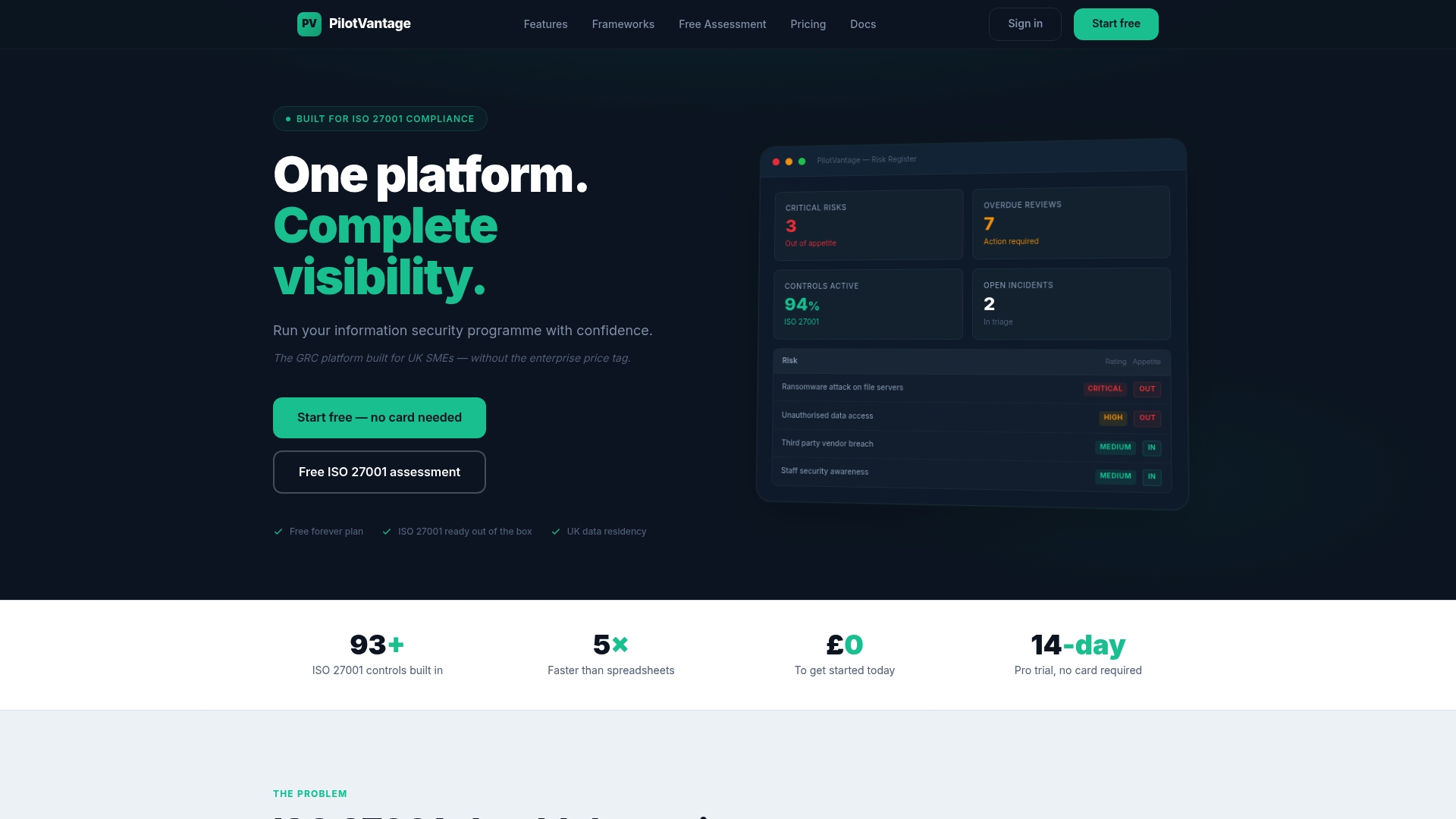
Explore how PilotVantage supports UK SMEs with practical tools to track third party risk alongside overall compliance. Visit PilotVantage and start assessing your risk register today with a plan that fits your team size and budget.
FAQ
What capabilities does PilotVantage offer for ISO 27001 compliance?
PilotVantage delivers essential features for ISO 27001 compliance, including dynamic scoring and heatmaps linked to incident records. The Risk Register allows organisations to manage risks effectively while preloaded ISO 27001 controls facilitate automatic Statement of Applicability generation. Users looking to enhance their compliance process should consider PilotVantage as a practical solution.
How does 3rdRisk compare to PilotVantage for managing third party risks?
3rdRisk boasts a strong AI native platform that covers multiple risk domains and regulatory frameworks such as DORA and NIS-2. While 3rdRisk excels in integrating automation across various areas, PilotVantage is specifically designed for UK SMEs pursuing ISO 27001 compliance efficiently. Consider PilotVantage for focused compliance needs tailored to smaller teams.
Which platform helps with vendor management in third party risk assessments?
PilotVantage helps organisations manage vendor risk by linking policy creation and third party vendor risk records together. This integration ensures that all documentation and compliance records are kept in one organised place, making it easier for operations managers to prepare for audits. The platform provides the necessary tools for effective vendor management within a clear compliance framework.
Can smaller teams use PilotVantage effectively for their compliance needs?
Organisations with 10 to 250 employees can effectively utilise PilotVantage for ISO 27001 compliance. The platform is built to accommodate small security teams and operations managers without needing full-time Chief Information Security Officer oversight. PilotVantage is free to start, with no card required, so you can load your controls and see your readiness score before committing to anything.
What integrations does PilotVantage offer for enhancing its utility?
PilotVantage integrates with the tools compliance teams already use: Microsoft 365 SSO, SharePoint document linking, and a full REST API on Professional and Enterprise plans, so you can connect it to your existing evidence sources and internal systems. Evidence can also be attached as files or referenced by URL from any system you already run.
Recommended
ISO 27001 certification cost UK: the real 2026 breakdown
Cyber Essentials vs ISO 27001: which one does your client actually want?