
SOC 2 certification cost is the total spend required to achieve and maintain a SOC 2 attestation report, covering auditor fees, remediation, compliance software, and internal staff time. Technically, SOC 2 is an attestation, not a certification. The American Institute of Certified Public Accountants (AICPA) defines it as an independent auditor’s report on your controls against the Trust Services Criteria. For small to mid-sized businesses, first-year total costs typically range from $30,000 to $150,000. That figure surprises most decision-makers who budget only for the audit invoice and overlook the significant internal labour and remediation work required before an auditor ever arrives.
What are the main components of SOC 2 certification cost?
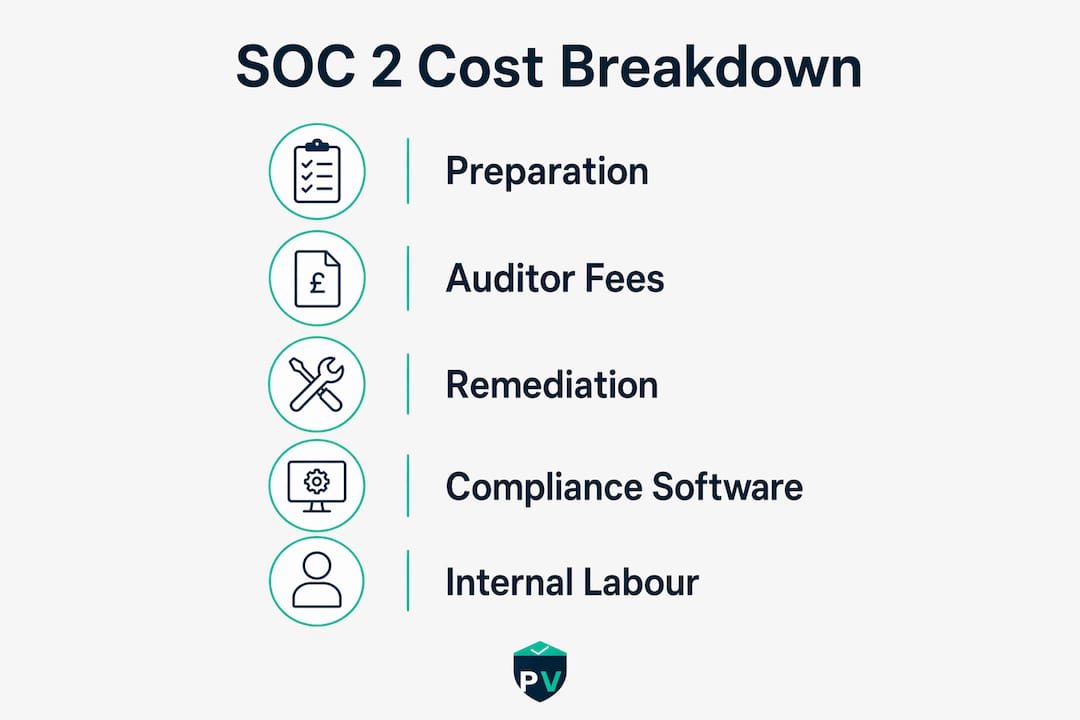
SOC 2 compliance cost breaks down into four distinct categories. Understanding each one separately prevents the budget overruns that catch most first-timers off guard.
Auditor fees
Auditor fees are the most visible line item, but they vary enormously by firm tier and audit type. Boutique firms charge $5,000–$25,000 for a Type 1 audit and $10,000–$50,000 for a Type 2. Big Four firms start at $30,000 and can exceed $150,000. That gap reflects brand premium, not necessarily better audit quality for an SMB. A Type 1 audit tests whether your controls are designed correctly at a single point in time. A Type 2 audit tests whether those controls operated effectively over a period, typically six to twelve months, and Type 2 fees run 40–60% higher than Type 1. For mid-market organisations, Type 2 auditor fees generally land between $20,000 and $60,000.

Remediation costs
Remediation is what you spend fixing gaps before the auditor tests your controls. Remediation costs range from $5,000 to $50,000 depending on your starting security maturity. A company with no formal policies, no access reviews, and no incident response process sits at the expensive end of that range. Organisations that already hold ISO 27001 or Cyber Essentials spend far less, because many controls are already documented and operating.
Compliance software
Compliance automation software handles evidence collection, policy management, and control tracking. Mid-market firms typically spend $15,000–$40,000 annually on these platforms. That cost is recurring, not one-off. The return is real: automation reduces the manual hours your team spends gathering screenshots, chasing policy sign-offs, and preparing audit evidence packs.
Internal labour
Internal labour is the most underestimated cost in any SOC 2 budget. Small companies should budget 100–200 hours of staff time for a first audit; mid-market firms should expect 200–500 hours. At a blended internal rate of £60–£80 per hour, that translates to £12,000–£40,000 in staff cost that never appears on a vendor invoice. This is why total first-year spend so often exceeds initial estimates.
Pro Tip: Run a readiness assessment before engaging an auditor. Identifying control gaps early costs far less than discovering them mid-audit, when remediation timelines compress and auditor fees climb.
How does company size, scope, and maturity affect SOC 2 audit cost?
Three factors drive more cost variability than any other: organisational size, audit scope, and your current security maturity. Each one compounds the others.
- Company size. Startups with fewer than 50 employees and a narrow technology footprint sit at the lower end of the cost range. Mid-market firms with 100–500 employees, multiple systems, and larger vendor ecosystems pay significantly more. Enterprise organisations face the highest costs due to audit complexity, longer evidence collection cycles, and greater remediation scope.
- Trust Services Criteria scope. SOC 2 audits are built around five Trust Services Criteria: Security, Availability, Processing Integrity, Confidentiality, and Privacy. Security is mandatory. Every additional criterion you include adds approximately 10–15% to the audit fee. Adding Availability and Confidentiality to a mid-market audit could therefore increase the auditor fee by 20–30%. That is a meaningful sum when the base fee already sits at $30,000.
- Security maturity. A company starting from scratch, with no formal policies or documented controls, faces the highest remediation bill. Low-maturity organisations can spend $30,000–$50,000 on remediation alone before they are audit-ready. A company that already operates a structured information security management system cuts that figure substantially.
- System complexity. The more systems, cloud services, and third-party integrations in scope, the more controls the auditor must test. Scope creep is a real risk. Every additional system added to the audit boundary increases both auditor hours and internal evidence collection time.
- Audit firm selection. Choosing a Big Four firm when a specialist mid-market firm would satisfy your customers’ requirements is a common and costly mistake. Specialist firms provide equivalent credibility for most B2B procurement scenarios at a fraction of the price.
The practical implication is clear: a startup with strong security hygiene, a narrow scope limited to the Security criterion, and a specialist auditor can achieve SOC 2 Type 2 for well under $50,000 in year one. A mid-market firm with low maturity, broad scope, and a premium auditor can easily exceed $150,000.
What are the hidden and ongoing costs beyond the initial SOC 2 audit?
The first-year audit is not the end of the spend. SOC 2 is a recurring annual commitment, not a one-time project. Many business owners treat it as a box to tick and then discover that maintaining the attestation requires continuous investment.
The key recurring costs include:
- Annual Type 2 audit fees. Renewal audits typically cost 30–50% less than the initial year, because your controls are already documented and your auditor is familiar with your environment. That still means $10,000–$30,000 per year for most mid-market organisations.
- Penetration testing. Annual penetration testing is a standard requirement under the Security criterion. Costs run $5,000–$30,000 annually depending on scope and the complexity of your systems.
- Compliance software subscriptions. Platform fees continue every year. Switching providers mid-cycle is disruptive and often more expensive than staying put, so choose carefully at the outset.
- Security awareness training. Annual staff training, phishing simulations, and policy acknowledgements are control requirements, not optional extras. Budget for a training platform or external provider.
- Legal and policy reviews. Privacy policies, vendor contracts, and data processing agreements need periodic legal review to stay aligned with your SOC 2 commitments.
- Internal programme management. Someone inside your organisation must own the compliance programme year-round. That is a real time cost even when a platform automates the routine tasks.
The total annual maintenance budget for a mid-market organisation typically lands between $30,000 and $70,000 once all recurring costs are counted. That figure rarely appears in the headline quotes organisations receive when they first enquire about SOC 2.
Pro Tip: Build a compliance calendar at the start of each year. Map every recurring task, from access reviews to penetration test scheduling, against specific months. This prevents the last-minute scramble that inflates both internal hours and external fees.
How can you plan and optimise your SOC 2 compliance budget?
Controlling SOC 2 audit expenses requires deliberate planning, not just cost-cutting. The organisations that spend least are those that invest most in preparation.
- Start with a gap assessment. A formal readiness assessment, conducted either internally or by a specialist consultant, identifies which controls are missing before the auditor clock starts running. Fixing gaps during preparation costs a fraction of what it costs to remediate findings during the audit itself.
- Limit your initial scope. Start with the Security criterion only. Expand to Availability or Confidentiality in year two once your programme is mature. Careful scope management is the single most effective lever for controlling first-year costs.
- Choose the right auditor tier. Specialist mid-market audit firms deliver the credibility your customers need at significantly lower fees than Big Four firms. Match the firm to your actual requirements, not to perceived prestige.
- Negotiate multi-year engagements. Many audit firms offer discounts for two or three-year commitments. Locking in a rate at the outset protects your budget from fee inflation and builds a productive working relationship with your auditor.
- Invest in a compliance platform. Automating evidence collection, policy management, and control tracking reduces internal labour hours substantially. The platform cost is real, but the reduction in staff time typically outweighs it within the first audit cycle.
The organisations that overspend on SOC 2 are almost always those that underinvested in preparation and chose auditors or tools that were not matched to their size and risk profile.
Key takeaways
SOC 2 certification cost is a multi-year investment, with first-year total spend typically between $30,000 and $150,000, driven by auditor fees, remediation, software, and internal labour.
| Point | Details |
|---|---|
| Auditor fees vary by firm tier | Boutique firms charge far less than Big Four; match the firm to your actual needs. |
| Internal labour is the biggest hidden cost | Budget 100–500 hours of staff time depending on company size and audit phase. |
| Scope controls first-year spend | Starting with the Security criterion only and expanding later reduces costs significantly. |
| Renewal costs are lower but never zero | Annual maintenance typically runs 30–50% of the initial year’s total spend. |
| Compliance platforms reduce ongoing costs | Automating evidence collection cuts internal hours and keeps audit fees lower year on year. |
The real cost most budgets miss
The most common budgeting mistake I see is treating SOC 2 as a project with a finish line. Organisations plan for the audit fee, maybe the readiness assessment, and then assume the spend stops. It does not. The controls you build must operate continuously, be tested annually, and be updated as your systems change.
The second mistake is underestimating internal labour. A mid-market operations team spending 400 hours on a first-time SOC 2 audit is not unusual. At a realistic internal rate, that is a six-figure cost that never appears on any invoice. When organisations later say SOC 2 “cost more than expected,” this is almost always what they mean.
The organisations I have seen manage this well share one habit: they treat compliance as a programme, not a project. They assign clear ownership, use a platform to manage evidence and policy cycles, and review their control environment quarterly rather than scrambling in the weeks before an audit. That discipline does not eliminate cost. It does make the cost predictable, which is the next best thing.
One more observation: the readiness assessment is not optional. Organisations that skip it to save a few thousand pounds routinely spend far more on remediation when gaps surface during the audit itself. Invest in the assessment. It is the cheapest insurance available in the SOC 2 process.
— PilotVantage
How PilotVantage helps UK businesses manage compliance costs
Managing SOC 2 and ISO 27001 compliance without the right tools is expensive. Internal hours multiply, evidence goes missing, and audit preparation becomes a fire drill.
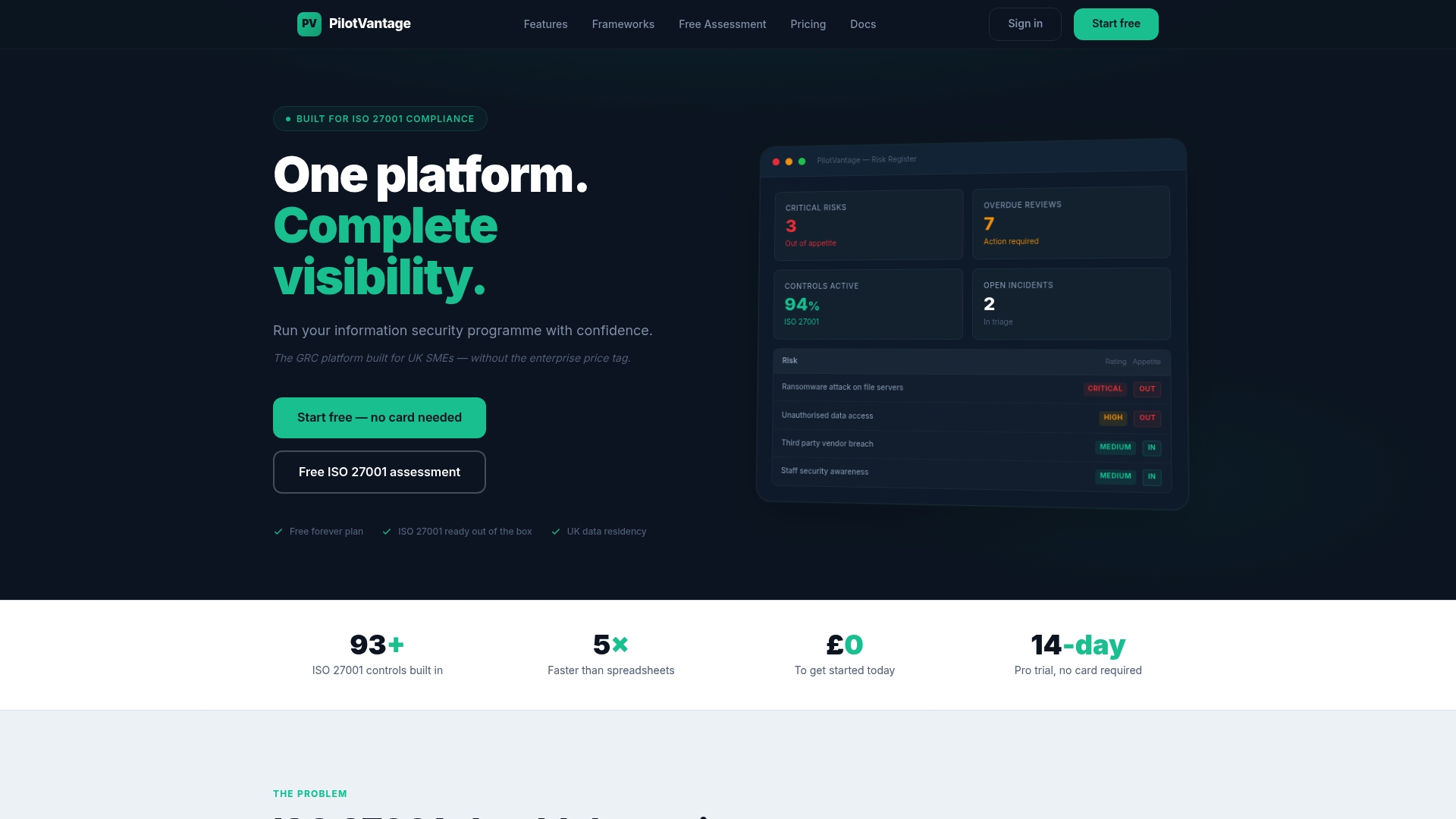
PilotVantage is a GRC platform built for UK small to mid-sized businesses that need to achieve and maintain information security certifications without enterprise-level complexity or cost. The platform centralises risk registers, policy management, internal audits, evidence collection, and staff training in one place. That means less time spent on manual tasks and lower internal labour costs across every audit cycle. Starting at £49 per month, PilotVantage gives your team the structure an auditor expects, without requiring a full-time compliance specialist to run it. Find out how PilotVantage supports compliance for growing UK businesses.
FAQ
What is the average SOC 2 audit cost for a small business?
Small businesses typically spend $15,000–$50,000 on a first-year SOC 2 audit, depending on auditor tier, scope, and security maturity. Internal labour and remediation add significantly to that figure.
What is the difference in cost between SOC 2 Type 1 and Type 2?
Type 2 audit fees run 40–60% higher than Type 1, because they test whether controls operated effectively over a period rather than just at a single point in time.
How much does SOC 2 compliance cost annually to maintain?
Annual maintenance, including renewal audit fees, penetration testing, and compliance software, typically costs 30–50% of the initial year’s spend for most mid-market organisations.
Does adding more Trust Services Criteria increase the audit fee?
Each additional Trust Services Criterion beyond Security increases the audit fee by approximately 10–15%, so limiting initial scope is one of the most effective ways to control costs.
Can a compliance platform reduce SOC 2 costs?
A compliance platform reduces the internal labour hours required for evidence collection and control tracking, which is often the largest hidden cost in any SOC 2 programme.
Recommended
ISO 27001 certification cost UK: the real 2026 breakdown
Cyber Essentials vs ISO 27001: which one does your client actually want?